Add this

Saturday, 29 May 2021

BOOK REVIEW: THE WORLD BENEATH THEIR FEET BY SCOTT ELLSWORTH

 My review of this book  was published in THE TRIBUNE on April 4, 2021. It is a fascinating account of the attempts made to conquer the ten highest peaks in the Himalaya in the last century. The article/ review is reproduced below.


Avay Shukla

“This is a book about the mountains. But it is also a book about the men and women who dared to match them.” These opening lines by the author provide the essence of this detailed narrative on conquering the Himalayas in the first half of the last century, particularly the ‘Achttausenders’, the 10 peaks above 8,000 metres. The lofty crown of the Himalayas remained the only unexplored territory on the planet where the human imprint was still missing.
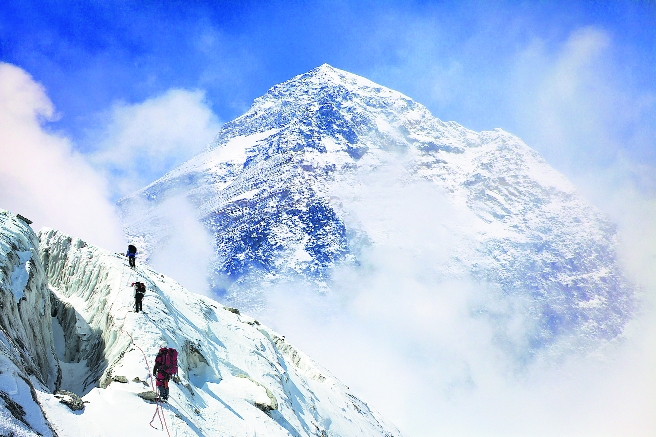
For long, nobody made it beyond 27,000 feet on Everest. The weather, logistics of maintaining a supply chain and pitching camp on narrow ledges and precarious cornices — the odds needed a superhuman effort to conquer.

This fascinating book is set against a twin backdrop: one, the evolution (skills, technology, knowledge) of mountaineering which was as yet a developing adventure activity; and two, the geo-political context of the time — the waning power of England, the rise of the Nazis in Germany, the aftermath of the Great War. In a proxy competition, the ‘Achttausenders’ became the focal point of rivalry between England, USA and Germany for global stature and influence. Conquering the Himalayas turned into a goal that would validate their respective ideologies and their greatness, in the eyes of their own people and the world.

The author’s focus, however, never shifts for long from the incredible men and women — the mountaineers and the Sherpas — whose heroic feats of resolve, perseverance, strength, courage and sacrifice are recorded in mesmerising detail. Like the three doomed Sherpas in the 1939 attempt on K2 who climbed an incredible 6,600 feet in one day from Base Camp to Camp Seven to rescue a stranded American climber. All four were never heard of again, just some of the hundreds these mighty peaks have taken as sacrifice for man’s presumption in challenging these eternal sentinels.

By the 1930s, the highest peaks of the Karakoram and Hindukush ranges had more or less been parcelled out among the three great powers: Everest “belonged” to the British, Nanga Parbat to the Germans and K2 to the Americans. None had been summitted in spite of numerous attempts; only Nanda Devi had been conquered, by an Anglo-American team in 1936, but it was not an ‘Achttausender’.

This book records, in captivating detail, the various attempts made to conquer these forbidding peaks: four on Everest by the British after George Mallory and Sandy Irvine’s ill-fated expedition of 1924, three by the Americans on K2, three on Nanga Parbat by the Germans who perhaps suffered the maximum casualties. But these intrepid mountaineers kept coming back again and again, in a love affair where rejection was just not acceptable. Their indomitable resolve is ultimately what this book is about.

The first ‘Achttausender’ to be climbed successfully was Annapoorna, the 10th highest peak in the world. This was achieved by a French team, led by Maurice Herzogg, on June 3, 1950. For the British, who had so far failed in 10 attempts on the Everest, this was a spur to redouble their efforts.

By this time, however, China had occupied Tibet and barred all foreigners from it; the usual northern route was no longer available and the peak could be approached only from its south face in Nepal. Fortunately for them, this route had been attempted by Shipton and Smythe in 1938 and the valuable information collated by them would now come in useful.

In 1953, the British launched their fifth attempt on Everest after Mallory’s failed 1924 expedition, this time led by Edmund Hillary. His climbing partner was Tenzing Norgay, by now a respected veteran, a Sherpa sirdar whose endurance, technical prowess and genial nature had earned the respect of mountaineers from all countries. Nobody had made it beyond 27,000 feet on Everest so far, and for good reason: the weather, the sheer logistics of maintaining a supply chain and pitching camp on narrow ledges and precarious cornices, the final “Hillary’s step” below the summit were all indomitable odds that needed a superhuman effort to conquer.

The first summit team comprising John Hunt and Da Namgyal fell short within sight of the peak because of the lateness of the hour: they could perhaps have attained the summit but would surely have perished on the way back to Camp Nine. Two days later, it was the turn of Hillary and Tenzing, and they reached the highest point on the planet at 11.30 am on April 29, 1953. It was the stuff legends and fantasies are made of; it was also a befitting gift to the new monarch of Britain, Queen Elizabeth II, who was crowned two days later, adding a timeless lustre to her coronation. This was not the moment to note that neither of the two heroes were British!

For the climbing buff, however, this book answers one of the two enduring mysteries that have haunted mountaineers for long. The first — did Mallory and Irvine make it to the peak 19 years before Hillary and Tenzing? — remains unanswered and will probably remain so forever. But the second — who among the latter two stepped on the peak first? — has been settled. The author quotes from Tenzing’s interview: “We went on slowly, steadily. And then we were there. Hillary stepped on top first. And I stepped up after him.”

It was a moment of triumph. But it was also a moment of sadness, for the last frontier had been vanquished. Romance should never end.


Saturday, 22 May 2021

MR. MODI MAY CONTINUE TO RULE, BUT CAN HE GOVERN ?

   If Bal Narendra had spent some more time in school instead of rushing off to sell tea at a railway station which did not even exist at that time, he would have imbibed some wisdom from a couple of old adages: Don't burn your bridges behind you because you may need them again tomorrow, and, Be courteous to the people you cross on your way up because you will meet them again on your way down. These would have stood him in good stead in this hour of his biggest political crisis when he and the country face a complete melt-down. For he has burnt every bridge, antagonised every peer and decapacitated every institution which could have helped him cross the troubled waters he now has to negotiate.

  Modi's destruction of India can be divided into three broad phases- Demonetisation, 2019, and Covid. In the first one he knocked the bottom out of the economy with demonetisation and GST and intimidated the media into a subservient silence. In the second, after winning another term, he demolished federalism by pulling down as many as nine elected state governments and rewriting our relationship with Kashmir, putting the goal of Hindu rashtra on the front burner with CAA and NRC, extracting the Ram Mandir judgment from the Supreme Court. In the third phase he put Parliament in the freezer along with the vaccines he never bought, upgraded the Hindu rashtra to a Corporate Hindu Rashtra by ramming through the three Farm laws and amendments to the Labour laws, quietly acquiesced to Chinese occupation of our territories, and made a horrendous mess of the management of the pandemic.

  These phases overlap, of course, but running through them is a malevolent common thread- of subjugation of constitutional and regulatory institutions, gross misuse of enforcement and police agencies, undermining of the judiciary, politicisation of the armed forces, an overbearing arrogance and insensitivity to public opinion, ruthless crushing of dissent and false propaganda and image building on a Goebbelsian scale.

  Modi and his fawning cohorts, who still wear their N-95 masks over their eyes instead of their noses, consider these phases as great achievements and milestones in the establishment of a majoritarian state. But they are now discovering that it is precisely these "achievements" which have defenestrated him and have made him unfit and unable to govern this nation any longer. He has systematically blunted the tools of governance and now finds he has no arrows left in his quiver with which  to confront the apocalypse facing the nation right now. He can blame no one but himself- and his hubris and insatiable appetite for power- for this.

  He talks now of everyone giving up their differences and standing behind the government to fight the pandemic as one united nation; this would be ironic if it were not so hypocritical. He has spent the last seven years in doing just the opposite: fragmenting the nation along religious, caste and regional lines, simply in order to accumulate more political power. His government has gone after every sub-set of society with a vengeance- students, farmers, intellectuals, journalists, scientists, blue collar workers, voluntary organisations, academia, even social workers and activists. There have been repeated nation-wide strikes against his disastrous policies- 250 million workers in November 2020 against the new Labour laws, one million doctors on December 11th, 2020 against the licence given to Ayurvedic doctors to perform operations, one million bank employees against the policy of privatisation of PSU banks; the farmers' strike and the OROP protests continue unabated. But he has remained adamant and intransigent. He has said not one word about the misery of the migrant labour. And he now expects these disparate groups to unite behind him?

  Take federalism, or in his own dissembling words, " cooperative federalism". He now expects that the Opposition parties should not criticise his mishandling of the pandemic and should support him. That's a bit rich, considering that his loudly stated objective is to wipe out the Opposition totally, a " Congress mukt" India and a " One Nation One Party" future. In pursuit of this he has used the CBI, NIA, ED, Income Tax Deptt. and friendly police forces to target leaders of political parties; the thousands of crores in the opaque Electoral Bonds have been gainfully utilised to pull down democratically elected governments in nine states, elections have been customised to suit the BJP's strategy.

  Modi has made a mockery of federalism, he is genetically unwilling to share power, just as he cannot share the credit for anything. Time and again he has maliciously encroached on the jurisdiction of states, whether it is by passing legislation such as the Farm laws or the GST Act or the law that makes the Lieutenant Governor the " government" in Delhi, showing utter contempt for the 20 million residents of the capital who have twice booted out his party in favour of AAP. He has changed the terms of the latest Finance Commission to siphon off more funds from the states' share of central revenues, he will not give them the promised GST dues, he uses the NIA, CBI and ED to thwart the state police forces from pursuing investigations that may embarrass his govt. or party. He completely usurped all powers under the Pandemic Act to deny the states any role or policy making in combating the pandemic, whether it be lockdowns, SOPs, vaccination production, sale or distribution. It is only now, when his gross incompetence and arrogance has blown up in his face, that he is making desperate attempts to throw the ball back in the states' corner. And he expects the states to " cooperate" with him on these terms?

 He expects the Opposition parties to cooperate with him, but when a former ( and much respected ) Prime Minster and Sonia Gandhi write to him with specific and sensible suggestions for fighting the pandemic, he ignores them with the haughtiness of a Kublai Khan. Even worse, he gets his underlings to reply to them in despicable language and to issue press statements accusing them of conspiracy and worse. He mocks a lady Chief Minister with cat-calls. And even after all this he is trying to portray himself as a victim of the Opposition's non-cooperation! One can't get any more delusional than this.

  He has calcified the institutions  which are meant to guide and advise the government, to act as circuit-breakers and watchdogs, as  bridges between the ruler and the ruled. Parliament has been made dysfunctional, the Supreme Court has been brought to heel ( even though some High courts are still holding out), the Election Commission is now just another subordinate govt. department, the Information Commission blocks more information than it releases. The whereabouts of the Lokpal is one of the biggest mysteries of the decade, bodies like the NHRC and the Minorities Commission simply issue notices which no govt agency bothers to reply to, the CAG spends more time redacting his reports than on auditing, on papering over the govt's misdemeanors ( and worse) than on highlighting them.

  Even the Union Cabinet is a window dressing for decisions taken by the PMO, and all reports indicate that Ministers count for nothing, which is why they have all gone into hiding during this terrible phase of the pandemic. Secretaries to govt. are not expected to contribute to policy making, they are required to simply carry out the PMO's orders. The best brains no longer come to the central govt., they prefer to stay in their states. In effect, therefore, Mr. Modi's reliance is only on a handful of bureaucrats ( predominantly from Gujarat) who pass muster on the loyalty quotient but have little else to recommend them. Under the CDS, General Vipin Rawat, even the defense forces are gradually moving to a dangerous point- " political" control instead of the constitutionally mandated " civilian" control.

  To conclude, Mr. Modi has locked himself up in his echo chamber and lost touch with reality. He has no ideas or instruments left to fight the pandemic with. The machinery of state has been made dysfunctional, the judiciary will take a long time to reassert its oversight role ( if ever), the mainstream media lacks all credibility, vast sections of the people have been alienated, the Opposition has reason aplenty to believe that cooperating with him is like hitching a ride on a tiger, the scientific experts have been sidelined in favour of Coronil and dark chocolate, people are finding it increasingly difficult to trust him, either in word or action. He is no longer seen in battle and the pandemic is more or less running its course. It will peter out eventually, and the Prime Minister will emerge from the debris and dust of Central Vista to take credit for it, but the corpses floating in the Ganga will be telling a different story this time. 

  Every party, institution, expert, state or service which could have helped Mr. Modi combat the pandemic has been deliberately bent, twisted, hollowed out or contemptuously discarded in his dispensation and rendered useless, and the Prime Minister is now like a General with no troops or weaponry. His vanity had convinced him that he could, like Icarus, soar to the sun alone, with no help from anyone. Like Icarus, he is now finding out that he should have heeded the advice of Daedalus. He may very well win again in 2024 with the help of his behemoth party, unlimited funds, undoubted oratorial skills, misuse of official machinery and an Opposition more fractured than a shale oil-field, whose leaders prefer to hang separately than to hang together. He will probably continue to rule but his quiver is empty and he has lost the capacity to govern. That, and not just the pandemic, is our collective tragedy.

Saturday, 15 May 2021

SUNRISE IN PURANIKOTI


                                                           A new dawn in Puranikoti

The sun doesn't just rise in my village of Puranikoti ( 7000 feet, pop 190 ) - it explodes. One moment the eastern horizon is a bluish hue faintly tinged with pink, the next there is an burst of gold over the Theog ridge-line, at the center of which is a searing circle of light. Somehow, this dazzling sphere always reminds of me the massive headlight beam of the Bullet engines of my youth, rounding the last curve before Kanpur station and bathing me in a sudden glare, drilling its burning light into my very soul. It's a childhood moment recreated in Puranikoti every morning. One is reminded also of the immortal description of the rising sun in The Rubaiyat of Omar Khayam:

" And lo! The hunter of the east has caught

  The Sultan's turret in a noose of light!"

                          
                                           The author's cottage snared by the hunter of the east
                                                     ( Photo by Sidharth Shukla )

There are, unfortunately, no turrets in Puranikoti, and no Sultans either; just four Additional Chief Secretaries, two already consigned to history and two still in harness, hoping to lasso the Chief Secretary's chair before the sun rises too often.

  I'm usually out of my house by 6.00AM for my morning walk through the dense forests of deodar, blue pine and oak, come winter, summer, monsoon or lockdown. There is an indescribable magic in the way the forest comes to life, after a cold night, under the benediction of the warming rays. I always marvel at the way the hidden avian orchestra tunes up, individual calls to begin with, gradually merging into a happy, almost Wagnerian crescendo: the cooing of the wood pigeons, the convoluted melody of the whistling thrush, the rat-a-tat-tat of the woodpecker, the chi-chi-chi of the Himalayan magpie, the haunting aria of the "koel". One never sees them, of course, for theirs is a different world, and it's perhaps better that way. Occasionally, however, one can spot a jungle fowl or a koklash sunning itself in a patch of sunlight on the forest floor or scurrying across the road into the undergrowth. An hour of this is enough to make one forget the sordid world we humans inhabit, with all our diseases of the mind, body and soul.


                                           Our morning -tea companion ( Photo by Neerja)

  I'm back for a cup of tea on our terrace by 7.00, and for the first scolding of the day. No, it's not by Neerja- she gave up many years ago when she discovered that, for a bureaucrat, no admonition counts unless it is given in writing and begins with " The Governor is pleased to inform you....." My first rebuke of the day is administered by a termagent of a " bul-bul" which has taken up unauthorised residence in my weeping willows and insists on a B+B arrangement. She arrives on the dot, cursing all the way, and demands her breakfast pronto. I initially tried giving her bird seed and bajra/ rice grains but she rejected them like a fussy dowager. She prefers biscuits( Parle G, the company will be happy to note), crisp rusk toast and my own favourite " namak paras". What Bul-bul wants Bul-Bul gets, or I don't get my morning cuppa! She sometimes brings along a friend or two if she feels the snack is up to the mark. The sparrows and tits come in her wake, after a five minute conference call among themselves, and oust the bul-bul by the sheer weight of numbers, in true democratic fashion.


                                                                     The scent of a rose

  There is another magic which the warming rays of the sun work on the trees and plants around my house. The gentle breeze gradually gets suffused by a medley of fragrance and subtle smells, all mingling into one  indescribable bouquet which no incense stick or air purifier can hope to match. That's because it does not have just one source, it is the breath of deodar, pine, oak, rose, hawthorn, apple blossom, wild daisy, hibiscus, hydrangia, willow, horse chestnut, morning glory and even the grass which I allow to grow wild. There is just no way I can pin down this scent and its components, just as one cannot describe what constitutes love or faith. You just know what it is, and you savour it , be grateful that you were allowed to experience it and to share it with the creatures of nature who are actually its true owners.. There is one man- made scent in this mix, however- the smell of burning wood. It is the contribution of Suresh, the village carpenter, who lights up his " hamam" or wooden stove sharp at eight o' clock every morning to heat the water for his ablutions. Since his hut is situated just above my cottage the smoke drifts down to me. But I don't mind at all- the smell mixes well with the fragrance of nature, and it reminds me of my trekking days, nights rather, getting to know better my friends ( and a certain Old Monk) before roaring camp fires!

  The morning traffic begins at about the same time. The first mover is Darshana Devi, a matriarch who lives with a large joint family about half a kilometer away. She has extensive fields of vegetable crops and a herd of seven cows and one mean looking bull. Promptly at eight o'clock the herd is driven to the forests above my village by either Darshana herself or one of her many daughters-in-law, its slow progress marked by the barking of the dogs in the various houses along its winding route. The bovine will graze on the slopes below Wildflower Hall the whole day and return in the evening. They have the right of way because here cattle class IS the premium class ( as Mr. Shashi Tharoor will be happy to note!)

  Half an hour later the twice-a-day HRTC bus arrives, on its way to Mashobra and Shimla. It is usually packed with school teachers, govt. employees and villagers who still nurture the fond hope that an application submitted in the HP Govt. Secretariat will get their long pending work done. They will, of course, be much wiser but sadder citizens on the return trip, but for the moment they are as chatty as my bul-bul and the sparrows. I take the bus sometimes to go to Mashobra bazaar when even the local mice start giving my empty larder a miss. Or when Ms Sitharaman, our Finance Minister, announces that the economy is looking up, for then I know that the only thing looking up will be the fuel prices, and it's time to either join Darshana's cows or put one's trust in the HRTC.

  The bus is followed by a few pick-ups taking the local vegetables to the subzi mandi in Shimla ( it's cauliflower these days), and by about nine o'clock our morning ritual is more or less over, and somnolence returns to Puranikoti. The sun has done its job here and can now move on to the great cities of the country. It is, after all,  at the heart of our existence and determines the rhythm of life. Ernest Hemingway put it very well in DEATH IN THE AFTERNOON:

" The sun is very important..... The Spanish say: El Sol es el major torero- The Sun is the best bull-fighter and without the sun the best bull-fighter is not there. He is like a man without a shadow."

I'm fortunate, I guess, that the rising sun casts a long shadow in Puranikoti, even though I'm a small man. 

Friday, 7 May 2021

LEST WE FORGET

   At the entrance to the Hall of Remembrance in the US Holocaust Memorial, Washington, the following words are inscribed:

    GUARD YOURSELF AND GUARD YOUR SOUL CAREFULLY LEST YOU FORGET THE THINGS YOUR EYES SAW.

The Jews in France have a shorter version of this exhortation: N'OUBLIONS PAS or LEST WE FORGET. The Jews have a long memory. It's time for us to develop one too.

  We need to retain in our collective national memory the near- Apocalypse the nation is going through and the persons responsible for it. There was a time when we stood in long lines in order to live; that was bad enough, but today we have to wait in longer lines in order to die, pleading for a can of oxygen or a hospital bed. It doesn't end there- we also have to wait in line to be cremated or buried, three to a pyre or grave. This is not the tryst with destiny Nehru had promised us, nor the acche din on the promise of which the present incumbent came to power.

  The disembowelment of the economy, the rendering of our social fabric, the defenestration of all constitutional values and bodies, the failure to protect our borders, the dumping of tens of millions back into the abyss of poverty from which they had just clambered out, the lying, hating and sporadic killing- all this in the first six years of this government- was bad enough. But it all pales into insignificance compared to what this regime is doing now.

 Walking the ramp in Davos instead of checking out the hospitals in his own country, preening with peacocks instead of holding meetings of the Covid task forces, preparing for elections instead of the second wave, spending billions on vainglorious projects such as the Central Vista and a private jet instead of ramping up vaccine production, listening to coronil quacks instead of the best scientific minds., reminding us of the NRC "chronology" instead of pursuing the corona's genome sequencing. Anyone could have seen that this was a recipe for armageddon, anyone, that is, but the Supreme Leader and his Sancho Panza, blinded by their lust for power and their troglodyte followers lobotomised by a toxic scalpel.

  We will never be allowed to know the actual extent of the enormous suffering the nation is going through today. The administration is on full drive to fudge, conceal, deny the number of covid infections or deaths. According to most credible international institutes, the genuine numbers are between ten and fifteen times what the government is reporting. That would mean at least 3 million infections and 40000 deaths every day- and we are yet to hit the peak. 

  Instead of accepting this with humility the government is putting out false narratives about similar number of deaths in the USA and Europe last year. Like most of its propaganda this too is a package of lies. In most countries ( except those like Brazil, whose Bolsanero is Mr. Modi's twin in every respect) the people died of Covid, of the virus, not because of lack of oxygen, ventilators, hospital beds and vaccines. And by the time the second wave came they had prepared themselves to receive it. Our government spent that time on patting itself on the back, turning a deaf ear to experts, growing beards, locking up journalists and ramming through Parliament laws that no one wanted.

  India has not suffered so much since the Bengal famine of the 1920s; then it was the British who caused it, today it is our own elected government. A country which is the "vaccine factory" of the world has been reduced to begging for vaccines and oxygen. Mr. Modi has made us a nation of beggars, global mendicants and pall bearers, while he himself demands votes as a matter of right and lectures us on how to become self-sufficient- "atmanirbhar". Instead, we are now " parmatmanirbhar"- left  to the mercies of a God who may or may not reside in in the statues and temples we are spending billions on.

  The prime architects of this cataclysm are, of course, the Deadly Duo who may not be named, who thrive on the misery and pain of citizens. But they are not alone in bringing this nation to its knees: they have been ably assisted by a whole host of willing collaborators, the pilot fish and parasites who  attend on behemoths, picking the crumbs from their insatiable jaws. We must not be shy of identifying them: the three previous Chief Justices of India who betrayed their office and their oath, the Election Commissioners who sold not only their bodies but also their souls for yet another piece of offal ; the officers of the CBI, ED, IncomeTax, Delhi police whose excesses need to be documented; a CAG who is more adept at redacting than auditing; the malevolent monk from Gorakhpur whose sheer savagery would make us question which type of God he worships; the media moghuls and anchors who, for a few pathetic crores of advertising, hid the truth from the citizens and encouraged the rampaging monsters to greater depths of depredation; a Solicitor General who lied through his teeth every time he stood up on his hind legs, whether it be about migrants, oxygen availability or incarcerated journalists; the cringing Cabinet ministers who preferred a bungalow in Lutyen's Delhi to a place in history; the heads of corporate hospitals who spent the last one year in padding hospital bills of dead patients instead of setting up PAS oxygen plants for the surge everyone knew was coming; the complicit bureaucrats who stabbed a nation in the back for an extension or a comfortable sinecure, the BJP spokespersons who continue to spout arrogance instead of empathy on every prime-time show.

  We must remember the Bobdes and the Sunil Aroras, the Arnab Goswamis and the Ravi Shankars, the Prime Minister and the Home Minister, Dr. Harshvardhan and the ICMR chief, the Amit Malviyas and Tejeshwi Suryas, the Smriti Iranis and Sadhvi Pragyas, and ask whether they bear any culpability for turning the nation into a purgatory. Dozens have already died for want of oxygen supplies, prompting one High Court to say that the government has  " blood on their hands," and another to term it as a genocide. In response, our Foreign Minister, having failed miserably in his own domain on all fronts, dismisses this as democracy at work! The sheer callousness and insensitivity of our 'leaders" is beyond belief.                                                                                                                                            We should remember each and every one, as the Israelis remember those who tormented them. A nation can grow only if it has a long memory, of the good times and the bad. As Ashwani Kumar quotes in an article in the WIRE: " The struggle of man against power is the struggle of memory against forgetting", for that is the only way that the excesses of power is called to account. In an ideal world, when the age of reason returns, these people should be held to account for what they have done to a once proud nation, for the millions of deaths, the biblical scale of suffering they have inflicted on a people who trusted them. That however is unlikely to happen for we are still the land of Buddha and Mahavira. But this must change in the crucible of grief and agony which is the India of today. Their names and their deeds should be recorded for posterity so that later generations never again make the mistake of trusting a Caligula in the guise of a Pied Piper.

We should never forget- or forgive.

Saturday, 1 May 2021

STATESMAN REVIEW OF " POLYTICKS, DEMOCKRAZY AND MUMBO- JUMBO."

   In the Literary supplement of 22nd April, 2021, the Statesman has reviewed my book POLYTICKS, DEMOCKRAZY AND MUMBO-JUMBO. The review is by my batch-mate Jawhar Sircar. Anyone who follows the news and reads the right publications would need no introduction to Jawhar. He belongs to the 1975 batch of the IAS and his last postings were as Secretary Culture, GOI and as CEO of Prasar Bharati. His is a (nowadays) rare public voice on governance, electoral probity and the values of our culture and traditions.


Friday, 23 April 2021

RACE TO THE BOTTOM

   The year 2020, according to the Chinese zodiac, was the Year of the Rat; it actually turned out to be the year of the Bat, but that's another story. In India it was the year of the Rat- race, and the race is nearing the finish line in 2021. The participants are all our constitutional bodies, vying with each other to be crowned King Rat. Little do they realise that the winner of a rat race continues to be a rat. It's a relay race to the bottom, and the devil take the hindmost. The two front runners are the Supreme Court and the ECI (Election Commission of India). The others- CBI (Central Bureau of Investigation), ED (Enforcement Directorate), NIA (National Investigative Agency(, Income Tax Deptt., NCB (Narcotics Control Bureau)- did not have to take part in this race; with their impeccable credentials they have been given a bye and are already at the bottom of the pit.

  The Supreme Court has led the relay for most of the time since 2014, with its indifference to the enforcement of fundamental rights, the citizens' liberty and the executive's accountability. Its pusillanimity has been one reason why we are being continuously downgraded as a democracy by international watchdogs, whether or not Mr. Jaishanker cares to listen to their barking. And the court has just got closer to the finish line by its shocking decision to hear a petition against the Places of Worship Act (1991), less that two years after it had (in the Ram Mandir case) reaffirmed the Act as a  bulwark against "retrogression", and called it a part of the basic structure of secularism and hence of the Constitution. Its strange decision to re-open the matter has, quite naturally, emboldened a Varanasi court to order the ASI to find out whether Gyan Vyapi mosque and the one in Mathura have been built over the ruins of Hindu temples. Ayodhya is playing out all over again, and we are getting closer to the bottom of the pit.

  For an apex court it has a surprising short memory too. Barely a year ago it had refused to entertain a PIL (Public Interest Litigation) to ensure the human rights of millions of migrant labour, but a few short months later it was compelled to intervene suo moto. Today again, its resounding silence is stupefying, as all around us the night sky is lit up by burning pyres, hospitals are running out of oxygen, vaccination centers are being shut, the case count has touched 250,000 per day- all while the men entrusted to keep the citizens safe are either campaigning in Bengal or bad mouthing any one who makes a sensible suggestion. The Supreme Court will not budge, which is bad enough. What is worse, however, is that it will not even allow a few plucky High Courts to do something about it. At least eleven HCs including Allahabad, Telengana, Calcutta, Gujarat and Delhi- have castigated the executive in harsh terms, the first of them ordering the UP govt. to seriously consider imposition of a lockdown in five districts. Within hours the SC stayed the order without citing any reasons, and- hold your breath!- asked the govt. to file an affidavit within one week, and posted it for further hearing after two weeks! Did it occur to the Hon'ble justices that in this period approximately 21000 more of their less advantaged country-men would die, at the current rate of fatalities? The court  left no one in any further doubt about where it may be headed- abrogating to itself the hearing of all petitions on Covid management. It did not specifically say so, perhaps, but that is the perception of many eminent lawyers who have severely criticised this order. As an ex High Court Judge, Justice Anjana Prakash put it- the higher judiciary has been reduced to a bureaucracy. And as she DIDN'T say- there is now no difference between the two, in many ways, if you get my drift. One doesn't know whether to laugh or cry at this state of affairs; it needs someone like Ghalib to describe one's feelings:

        " Koi ummeed bar nahin aati,

           Koi soorat nazar nahin aati,

           Aagey aati thi dil pe hansi,

          Ab kissi baat pe nahi aatee."   

  Of late, however, another constitutional institution, the ECI (Election Commission of India) appears to be overtaking the judiciary and may just pip it to the bottom. It had faltered a bit in 2019 when one of its Commissioners had shown the courage to dissent, but he was soon kicked upstairs and forced to quit the race- it's not easy being Caesar's wife when one may have a few "flagrant delictos" of one's own tucked away between the sheets. Since this stumble, however, the ECI has picked up its pace and has now entered the final lap, the Bengal and Assam elections, with a terminal burst of blinding speed.

  Even the inventive Piush Goel, who thinks Newton and Einstein are the same person and who has lately emerged as an authority on how dying persons can consume less oxygen, would be hard put to explain some of the ECI's recent decisions. How is it that an institution which slavishly toes the BJP line of One Nation One  Election needs eight phases and one month to conduct elections in just one state? And three phases to carry out polling in one district? Are these elections or eight course meals cooked by the BJP chefs and served by the ECI, like the elaborate "dham" of my state? It certainly doesn't say much about its ability to conduct Parliament and Vidhan Sabha elections simultaneously.

 West Bengal these days seems like an occupied territory, what with 1000 companies (or about 130,000) personnel of the CAPF (Central Armed Police Forces) deployed there to ensure "peaceful" polling. I'm sure it would take fewer cops to conduct elections in POK. To use the words of Nalini Singh in a recent article, this looks more and more like "democracy at gunpoint "- to selectively intimidate the voter and provide friendly fire for the shenanigans of one political party. And the "peaceful" part, of course, met a violent end when four voters were shot dead last week by a force with no training in crowd control, more used to reading your passport (upside down) in airports than in handling legitimate protesters. Talk about wolves guarding sheep.

  In the words of the TMC delegation, every action and decision of the ECI suffers from inaction, under action or over-action, all carefully calibrated to suit the hand that feeds it: the minutely planned phases to enable the ruling party's well funded carpet bombing, the shameless partisanship in handing out bans, the volte face on the issue of Electoral Bonds, the refusal to club the last three phases of polling into one, the spurning of the demand to ban rallies to check the spread of the virus. And why does it continue to reject the demand to count the VVPAT paper slips, on the specious ground that it will take too much time? Are a few more hours of their time more important than the confidence of the citizens in our electoral process? After all, our democracy did survive the pre-EVM days when each ballot paper was painstakingly counted. Has the ECI even bothered to read the report of the Justice MN Lokur committee which has categorically stated that EVMs can be easily hacked? The only reason we are still a "partly free democracy" is because of our hitherto fair election process, in which parameter we scored 4 out of 4 in the Freedom House markings. Even that has been put in jeopardy now by the incomprehensible dogmatic attitude of the ECI.  

  I'm old enough to have seen an Election Commission that used its legs to stand up straight and tall, not as something to curl its tail between. I've conducted one state and one Parliamentary election as District Magistrate, and have been ECI Observer in four states at different times, including in the golden age of TN Seshan and Lyngdoh.  Protected by a fiercely independent Commission we took no shit from anyone. Yes, there were glitches, but no one doubted the Commission's intentions. In my time polling booths were occasionally "captured" in the old fashioned way, by sending in a bunch of armed goons. It was a risky operation, reparation was swift, the offence was not deniable, and repolling was invariably and swiftly held. On the other hand, the growing perception now is that the  hijacking of elections today is much more simple and sophisticated: that all it needs is control of the ECI, and perhaps of the EVMs. The ECI has had innumerable opportunities to disprove this perception, in court and outside; tragically, its obdurate conduct instead only reaffirms this perception.

  Things have come to such a pass that very soon we may be able to buy EVMs on Amazon and Flipkart, and there are suggestions on social media  that the ECI may as well be privatized along with BPCL and Air India; let it be sold to the highest bidder. That way at least the country's exchequer too shall get some money, rather than just one party getting all the benefits and the Election Commissioners getting their Governorships and what-not.

  Since 2014 India has already slipped down on 47 internationally accepted indicators of good governance, human rights and social cohesion. It doesn't really make much of a difference which of the two -ECI or SC- reaches the bottom of the pit first. The country is already there.


Saturday, 17 April 2021

BOOK REVIEW: KINNAUR-UNLIKELY TALES by JOGISHWAR SINGH.

 A TALE OF TWO LOVE AFFAIRS.


   Jogishwar Singh ( IAS 1976 ) is the bureaucrat who literally came in from the cold- from his almost ten thousand feet high perch as Deputy Commissioner of Kinnaur to the pleasant cantons of Switzerland. He is also a most unusual civil servant, probably the only one who was selected twice for the IAS, rejected it outright the first time and resigned it the second time after eight years' service for a greater love. The fact that he hails from redoubtable Punjab must have had something to do with it, because I certainly can't see someone from U.P. or Tamil Nadu doing this !

  His book is a delight to read- anecdotal, honest, impish and at times outrageous in his comments ( such as the one about the ladies of Kinnaur: " I could smell her from a distance since local people are not known to bathe very often." ). But his love and fascination for this most remote and beautiful of Himachal's districts comes through strongly, as does his passion for Lia, the Swiss girl who carried him off to Switzerland in 1984. This book is, therefore, essentially an account of these two romances ( with some "sexual gymnastics" with an Italian Mona Lisa thrown in to establish his Punjabi credentials).

  Jogishwar recounts his posting as Deputy Commissioner of Kinnaur in 1982, his service there for two years before resigning: how he falls in love with a visiting Swiss tourist who fully reciprocated his ardour. After their marriage he moved to Switzerland where he did a doctorate from Heidelberg University ( on alternate credit systems in Kinnaur), tried to join the UN but failed because he lacked the necessary "connections", went on to banking for reasons he has not fully explained in the book. He had a very successful career as a banker and finally hung up his boots ( including the banker's pin-striped three piece suit, presumably) in 2018. He is now a free-lance consultant, and I shudder to imagine what kind of advice he gives his clients, if this book is anything to go by!)

  The book honestly reveals his fascination for the powers and authority of a Deputy Commissioner in a remote region, and Jogishwar exercises them to the hilt, with scant regard for the Conduct Rules or simple prudence- all in the public interest, of course ! When an obdurate Finance Deptt. will not sanction him an official car, he withdraws cash from the Treasury, goes to Chandigarh and helps himself to the latest model ( The Ambassador and I ). When a smoker on a road blows smoke in his face  he is hauled to a police station to be taught proper civic behaviour ( Gone with the Smoke). A butcher who sells rotten meat is made to publicly eat it, raw and with the maggots and worms, rather than just pay an ineffective fine ( Don't Cheat on Meat). Jogishwar has his own ways of dispensing justice, without reference to the IPC or the CrPC.

  He has little patience for hide-bound rules or notions of Victorian propriety. He brings in lady visitors to the restricted area of Kinnaur without the prohibitive Inner Line Permit because he cannot abide the red tape ( Mona Lisa in Kinnaur), relying on the   "lese majesty" effect of the DC's flag. He smuggles Lia into his room in a training institute as his wife ( Hyderabadi Masala) leaving his colleagues to stew in the juice of their curiosity. He insists on deploying a police pilot car in advance of his official vehicle ( against the rules, naturally), and is overjoyed when an overbearing Brigadier is tricked into saluting him ( The General's Salute). But on at least one occasion the young DC is caught on the backfoot: on a night halt in a remote place in Nichar the local Pradhan gifts him a young Kinnauri girl for the night  (The Pradhan's Gift in Nichar), apparently a local custom to express hospitality. But it was too much for even Jogishwar who sends her away, much against the run of play.

  It's not all fun and games in Kinnaur, however. Jogishwar takes his job and responsibilities seriously. He has visited every remote village in his district, sometimes trekking as much as sixty kms to reach the more inaccessible ones, like Hango, Chuling, and Namgya. On one occasion, on an April visit to Chitkul  , the last village in the Sangla valley, he remarked on the beauty of the place. The local Pradhan had a differing view, informing the young DC that it was completely snow bound in the winters and no official or tourist visited them then. Jogishwar promised the Pradhan that he would come and spend New Year's eve at Chitkul that year. And he kept his word, much against the advice of his staff and Tehsildars, tramping for eight hours over waist deep snow, only to find that the Pradhan himself had betaken himself to Shimla for the winters! He has studied, and worked on, alternate credit systems in Kinnaur and conducted a national Census even though all govt. employees were on strike.

  He is also an environmentalist at heart: he opposed any plans for mass tourism in his district, arguing that the fragile topography and unique culture of Kinnaur would be seriously endangered by hordes of visitors and vehicles. This brought him into some conflict with the local MLA and Speaker of the Assembly, the legendary T.S.Negi, who, however, deferred to his DC's views and did not force his own on him. Subsequent events have proved how right Jogishwar was in opposing over-tourism. Incidentally, the author devotes a whole chapter to Mr. Negi, indicative of his high regard for the bureaucrat turned politician.

  The pre-ordained, three year, Inner Line Permit romance with Lia is true to the character of the man, not exactly love at first sight but love in hind-sight. It took Lia a midnight walk to the thick-headed DC's residence for Jogishwar to realise that this was the girl he wanted to marry. His mother was not too happy, he confesses. When she was looking for a bride for him he had insisted that any prospective candidate must tick four important boxes, the fourth being ( in his own words): she must be large breasted. We are informed that Lia did not tick the first three boxes, about the fourth he remains reticent!

 I finished this book in two sittings. Unlike most of his ilk who too have penned their memoirs, Jogishwar does not preach or pontificate. He shares with the reader the joy of being a young DC in a unique place, the satisfaction of cocking a snook at the staid bureaucracy of which he too is a part, the miracle of how a chance encounter metamorphosed into a love that changed the whole trajectory of his life. It is precisely these qualities that make this book so readable, especially for those who have served in Himachal. His has been a most unusual life and this book makes for very interesting reading for Jogishwar does not pull his punches. It's probably a good thing he decided to quit the strait-jacketed ranks of the IAS, for one can't help feeling that had he continued in the service he would have either become a Chief Secretary or  would have been charge-sheeted for his out-of-the-box nature. There is no middle ground for this raconteur! 


Published by SANBUN PUBLISHERS, NEW DELHI 110028

124 PAGES

RS. 1995.00